Wednesday, December 15, 2010

"a headache for three days"

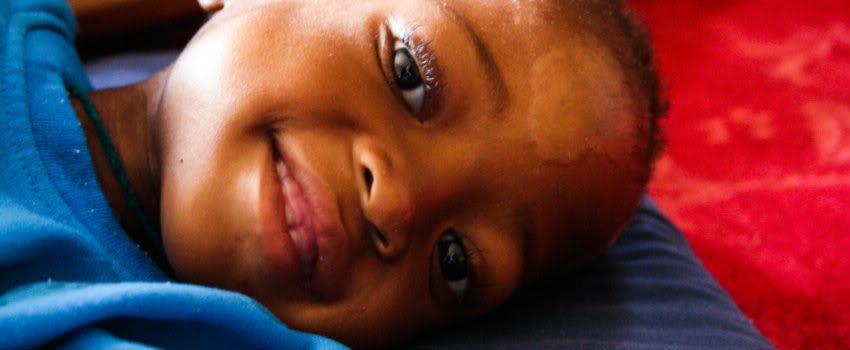
Another baby boy arrived at TTL yesterday, another child orphaned shortly after birth. Born on November 7, his mother died on December 8, likely from complications of HIV/AIDS.


Like many people in Mokhotlong, she died amidst a sad and troublesome dearth of information, after seeming healthy and then having "a headache for three days."


From a Western perspective, it seems ridiculous when death is explained away as the result of a sudden ailment as seemingly innocuous as a "headache," or "chest pain," but here it happens all the time.


In Mokhotlong, those reasons seem more common than anything else in explaining death. Among our clients who have lost one parent or both, undiagnosed ailments are at the top of the list of killers, while "cancer" and "heart attack" are almost unheard of.


Kabelo, the little boy now in TTL's care, was brought here by his maternal grandfather, an old man who is already taking care of two other children with the help of his sister. They are another example of the elderly taking care of the young, with the middle generation wiped out by AIDS.


While Kabelo's grandfather and great aunt seem to love him, they don't have the resources or energy to provide the constant care a newborn needs -- especially with two older children to look after.


Thankfully, Kabelo seems pretty healthy, and a temporary stint at the safe-home will serve him well as his grandfather figures out the best care situation for him. He's a cute little guy, born heavy for Basotho children at more than 7 pounds, and is eating well.


The only sad part about his health is that, in a way, it is yet another indication of how tragic his mother's death was, as it is proof that she was breastfeeding him just fine until the sudden onslaught of her "headache."


Her death adds Kabelo to the already staggeringly high number of orphans in Lesotho. TTL will do what it can to help, but we can't replace Kabelo's mother.


With death, it's always hard not to ask why. It's harder still when the only available answer is "a headache for three days."

Monday, December 13, 2010

A Holiday Message

Dear family and friends,

I am writing to you for a reason.

Of course, I wish you all Happy Holidays, a great 2011, warmth and joy and all the things that make the holidays in the U.S. so special. But really, that's not the reason I'm writing.

I'm writing because I know your hearts, because you're the people I count on, because I know you can help the community I have gotten to know this year. I am writing on behalf of children I've gotten close to, who don't have their own network of family and friends to rely on but who need support this holiday season more than anyone in the world.

I'll be spending this Christmas and New Year's in Mokhotlong, Lesotho, where I have been working since February with Touching Tiny Lives, a local charitable trust that provides life-saving support to children under five in this poor and HIV/AIDS-ravaged country in southern Africa.

What I have seen this past year has been both profoundly unnerving and profoundly uplifting -- horrible illness and unspeakable malnutrition, but also a locally-run organization that is making a difference, saving the lives of children, one child after another.

The story of one of those children, 16-month-old Ntseliseng, speaks to both the sadness and the hope. When she arrived at TTL in April, she was an orphan on the verge of death, fighting undiagnosed HIV and other illnesses, an infestation of scabies, and malnutrition so severe that her tongue barely fit in her sunken cheeks. Her stomach was distended from hunger and her legs were completely undeveloped.

Three months later, after 24-hour intensive care and nourishment at the TTL safe-home, Ntseliseng had transformed into a happy and healthy toddler, on a successful regimen of medication for HIV and taking her very first steps. She was soon reunited with a loving aunt who TTL helped find and who has stepped forward to be her full-time caregiver. She remains in good health, and her future now looks bright.

This year I've seen many children like Ntseliseng, and it's been difficult. Sometimes I curse the rotten luck these babies have received in life, born orphaned into pain and poverty. Sometimes I question why I am so lucky, with all my family and friends, with my health. Sometimes I feel unavoidably uneasy about the disparity. When I sat down to write this letter, I felt the same sense of awkwardness we all feel when we ask for things from others.

But I don't care about that. I want you to know that this isn't about me. It isn't really about you, either. It's about all of us realizing that $50 can literally save a child's life, or that $100 can give a child another chance, a chance he or she certainly deserves after getting such a raw deal at the start.

Touching Tiny Lives here in Mokhotlong receives a majority of its funding from the Touching Tiny Lives Foundation in the U.S., the organization that hired me to work here and an organization that survives on donations from individuals like yourselves.

With the funding from TTLF, the staff of TTL provides transportation for children to mountainous clinics and hospitals that are otherwise impossible to reach; delivers life-saving food packages to children in their rural villages; rehabilitates the most ill and malnourished babies in the TTL safe-home; and supports HIV-positive pregnant women and new mothers so they don't transmit the disease to their babies.

Even a small amount of U.S. money goes a long way here in Lesotho. Please help. I wouldn't ask if I didn't know how much your support matters. Donations referencing this letter or my name can be made at www.touchingtinylives.org.

All my love and thanks,

Kevin

Coughing in a Storm

This weekend passed by in what seemed to be one massive rain cloud, a cloud that would not pass through town itself, that lingered and dumped much-needed rain on Mokhotlong in torrential bursts and constant drizzles.


An ever-changing pattern of angry dark grays and wispy light grays clouded in around the mountain peaks, obscuring them from view and making the town itself seem like a giant ship cast out and isolated in a raging storm.


Here the rain is a joyful event, it means life, and the people in town seem to hole up away from the pervasive wetness not in dreary acceptance, but in appreciative retreat -- retreat from wetness and worry all at once.


Amidst the bubble of rain, though, even in TTL's warm and dry safe-home, Nthabiseng's slight cough and congestion progressed to the point where her breathing became worrisome -- where we thought she could soon stop breathing all together, and at any moment. We took her to the hospital on Saturday afternoon, and there she was looked over by the doctor and admitted in the children's ward. A chest X-ray was taken today, but no doctor has reviewed it yet.


So, while the sky has opened up at last and the sun has made its first appearance in days, we are still in the dark as to Nthabiseng's condition.


Here, what seems like a chest cold can just as easily be TB. It's a scary thing to wonder about the fate of a child who one day is giggling happily, and the next is laboring to breath, and whose antibiotic prescription doesn't seem to be working.


"Do you think it's TB?" you find yourself asking the doctor.


"Could be," he says.


"Ach," you say, and you look into the sky and the clouds billow greatly there, and you wonder about it all and the fate of one tiny child in such a big world.

Saturday, December 4, 2010

Mokhotlong Marathon!

TTL Fellow Eric finished the Mokhotlong High Altitude Marathon strong today, and when we got back to the safe-home, the bo'me gave him lots of cheers:

Wednesday, December 1, 2010

What a World AIDS Day

Yesterday I found myself taking styrofoam-encased lunches from the hands of a doctor and putting them into the hands of poor Basotho -- children and women and men -- one after another after another.


I was just one cog in an assembly line of food distribution. The pace was rapid, with wranglers urging the long line of children -- separate from the long line of adults -- to move quickly past me as I did my best to keep up. A lunch would come into my right hand, I'd pass it to my left hand, then pass it into the hands of the next child, even as my right hand was accepting the next lunch.


Yesterday was World AIDS Day, and the food distribution was part of a large-scale HIV-testing event planned and paid for by the Baylor International Pediatric AIDS Initiative, a close working partner of TTL's.


The event was supported by TTL and a host of other groups -- including Kick 4 Life, which uses the influence of sports to fight HIV, and the Ministry of Health. Counselors and nurses from the Mokhotlong Hospital and the St. Martin clinic were on hand, as were representatives from the World Food Programme, Peace Corps and a few other organizations.


Aside from lunch time, which saw all hands on deck helping with distribution, Team TTL -- Eric, Matello and I -- spent the day weighing and measuring all children under five, screening them for malnutrition.


About 200 people, many of them young students, were tested for HIV and given a free meal, and TTL screened about 20 children. A handful were underweight, and we are going to follow up with them as potential clients.


In the morning we set up tents around the local school, and various testing stations were established therein. TTL was stationed in a classroom with a dirt floor, a few posters of multiplication tables and fractions on the walls and a crumbling drywall ceiling that was falling to pieces beneath the corrugated metal roofing. With us were a few nurses from Mokhotlong Hospital who were giving immunizations to the same kids we were seeing.


Throughout the morning and into the afternoon, we weighed and measured kids as they cried for fear of the scale and the length board. I got peed on twice, which is par for the course.


At moments when the stream of babies slowed, I watched out the window as school children stood in single file lines, waiting for their turn to be tested. Many of them were completely without their caregivers, and I thought about how scary the process could potentially be.


Their status wasn't told to them right away after the test. Instead, different cards were handed out requesting them to return to the clinic with their caregivers at different times for the results. This made me feel a little better, but I felt bad for the kids nonetheless.


Still, their being tested is important, and events like this one make a real difference.


As the long day winded down, we again packed the vehicle with the tents and climbed inside. Two counselors from Mokhotlong Hospital had gotten a ride with us, and climbed in again for the bumpy two hour ride back to Mokhotlong.


On the ride back, I pictured again the smiling faces of the children as they rushed past me and I stuck a lunch into their waiting arms, saw again the little red ribbons pinned on their shirts that signified they'd been tested.


World AIDS Day 2010. What a day, I thought.