Wednesday, June 30, 2010

Caught up and caught off guard

Lately, I've been caught up -- namely in a million administrative tasks. They are the duties that help make this place run smoothly, and they come in floods.


Then, yesterday, I was caught off guard -- once by a moment of happiness, once by a moment of sadness.


In the midst of my administrative work, both moments were like sudden flashes of light in a dark room: shocking enough to make me close my eyes for a second in adjustment, and bright enough to give me a clear dose of reality apart from my office bubble.


The first occurred when I slipped into the playroom to take another look at the babies. We have a total of eight now.


We have Ntseliseng and Selloane, who I mentioned last week, as well as Nthati, who has been here the longest and who seems to be doing really well. We have Mamello, who is three months, Karabo, who is wild at one year, and the twins Bohlokoa and Bohloeki, who are staying strong and doing better.


We also recently took in Mpho, a tiny little boy who was born on June 6 at less than 4 pounds and referred immediately to TTL. He was born a twin, but his sibling didn't make it.


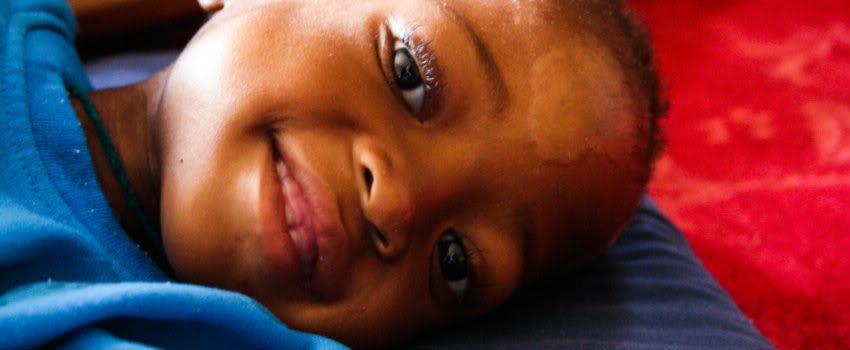
My moment of happiness came with Ntseliseng.


I've been trying to get her to use her legs more and more, pulling her onto them and holding her hands as I lead her forward. In the past, she has burst into tears or sort of welled up in resistance each time I attempted this exercise. Her legs are tiny, and it's tiring for her to use them.


But yesterday, the reverse happened. I pulled her onto her legs, and amazingly, she laughed. I walked her forward, and she giggled with each step. I verbally encouraged her more and more, and she looked back at me and then around the room, as if to say, "Hey, everybody, look at me!" She kept laughing with each smile from the bo'me.


For me, it signified a possible turning point in her development. If she associates making an effort to use her legs with accomplishment and encouragement, maybe she'll start making that effort more often.


After a few feet, I stopped backing away from her, and let her fall into my chest. She pulled herself up to a standing position, holding onto my shoulders. She was out of breathe a bit, but smiling. I smiled back.


It wasn't long after when my moment of sadness came.


I was sitting in TTL's front office when one of our outreach workers, Kokonyana, came in with a mother and baby. The mother pulled up the shirt of the infant, who was crying, and I could see what appeared to be a bulge in the baby's side disappear and then reappear on her other side. It seemed almost as if it were pulsating back and forth.


Kokonyana gave me the baby's bukana, and I saw the words "bilateral hernia" scrawled in black pen.


I'd never heard of such a thing, but guessed what it meant.


I also saw that the Mokhotlong hospital had referred the baby to the hospital in Maseru. Another one of our outreach workers told me the mother is mentally ill, a complicating factor in the entire situation. I looked at the nonchalant way the mother held the baby, and heard the wail of the baby, and cringed.


We supplied the mother with a fresh can of formula, a bottle brush and soap, and then took her back to the Mokhotlong Hospital to see what we could do to help facilitate her trip to Maseru. We were able to get her admitted to the C Ward, where she will receive assistance and transportation to Maseru. It's all we could do at this point, but it didn't diminish my concern.


Both moments, like I said, were like sudden flashes of light. I think I am still blinking from both...

Thursday, June 24, 2010

Striking Transformations

I opened the door to the play room today and there they were: Selloane and Ntseliseng, looking back at me and smiling from ear to ear.

"Hi!" I said, waving.

They both giggled. Ntseliseng waved. Selloane bolted in my direction, and I scooped her up and spun quickly in a circle. She grinned, her dark eyes seeming to sparkle, and I laughed out loud in amazement.

In the last few days, both girls seem to have hit a turning point in their recoveries, and suddenly seem like brand new, energized versions of themselves.

The transformations are absolutely striking.

Selloane, who will be three in October, was so shy for so long. She used to sit quietly and stare. When she was sick, she frowned and looked miserable. She didn't want to be held or played with or, as far as I could tell, acknowledged.

But ever since her fever broke, she's been opening up and gaining weight, going from 7.2 kg on June 12 to 8.2 kg today. Her face has filled out, and while it used to be a big event if she showed even the slightest hint of a smile, she now gives big, cheesy smiles all the time. She literally looks like a different kid. She's loud, happy and expressive, wandering around the playroom with all the energy a girl her age should have.

Ntseliseng, who will be two in September, is smiling and making lots of noise now as well. She still isn't walking, her legs still tiny and extremely underdeveloped, but she is crawling and scooting on her butt more and more. She happily ate her entire lunch of carrots, chicken and rice today, is breathing regularly and looks better and less gaunt every day.

All this after being on death's doorstep so recently, and being on a roller coaster of health fluctuations for the last month. Ntseliseng got here tiny and ill, recovered and started to do better, and then hit the wall of illnesses that swept through the safe-home last month and spiraled quickly downhill. I wasn't sure she was going to make it. There were moments when I thought she would stop breathing at any second.

But now she seems to be back on track. She's gone from 5.6 kg on June 6 to 6.7 kg on June 12 to 7.1 kg today. She's getting less and less fussy with me when I try to pull her onto her feet and exercise her legs.

After the happy greeting I got walking into the playroom earlier today, I played with Ntseliseng and Selloane for about a half hour just before lunch. They both like playing a game where they stick their tiny hands toward my face and I pretend like I might bite. They shriek in laughter and yank their hands away. Ntseliseng also likes playing a game where she puts her face less than an inch from mine, then looks directly into my eyes until she or I break and roll away in laughter.

At one point I was on my back, and Selloane sat on my chest smiling as she watched Ntseliseng pull herself up onto my chest as well. They both seemed happy and content and comfortable, laughing down at me -- such a far cry from a few weeks ago.

I caught myself marveling at their improvement, and again laughed out loud.

Tuesday, June 22, 2010

One second, a thousand years...

I can't believe I've been here almost five months.


Then again, sometimes I feel like I've been here forever, and so has everyone I meet here, like we're all locked in some twilight-zone representation of the world, one that only changes at a glacial pace and will continue on doing so forever through its peaks of sadness and cheer.


Time here is at once ephemeral and permanent. It is strange from the smallest sense of the word to the largest sense of the word -- from one second to a thousand years.


One second here can last forever, and lock into your consciousness for good -- packed so densely with emotion that you'll never forget it.


When a baby is struggling to breathe and you are sitting with her in a hospital with no resources, and a cold, dark winter night is all around you and seems like it is closing in fast to take hold of both you and the little one in your arms, seconds seem to last an eternity. They tick away in your head and you count them slowly, happy for each one and scared for the next. Each new second is your connection to the future, but might also be that sad thing they call a "Time of Death" for the helpless little baby in your arms. You hold on tighter.


One second.


Sometimes, for just one second, when I'm just waking up or am about to fall asleep, I will forget where I am. And then there is the next second, when I remember, and my mind and my body again go through the physical shock and awe and confusion and wonder and shivering adjustment of realizing that I am in Mokhotlong, at the edge of the world, or the peak of the world, and that I am staying here.


Just one second is time enough here for vast changes to occur. Things happen in a flash and you're left to wonder why and how.


On the other end of the spectrum, a thousand years can seem trivial here. It's easy to get the feeling that the impact of a thousand years wouldn't be that great here, wouldn't change all that much, because the last thousand years haven't changed much here either. In certain villages, I feel like I could fall asleep, wake up a thousand years ago or a thousand years from now, and be absolutely none the wiser.


When I set out on outreach, and hike to a rural village and find nothing but a few stone rondavals with thatched roofing on the edge of a cliff, and all around me there is the enormous blueness of the panorama sky so big I wonder if its grounded and I'm the one floating above, I think of 2,000 years ago and wonder if people were living the same way back then. And then I think, yes, they were, and the feeling is strange. Thousands of years seem to flap away in the wind and I think, for just a split second, that I could be in Biblical times. The cell phone feels strange in my pocket, like a useless rock. No reception anyway. I'd be better off yelling from mountain to mountain like the locals, whose voices seem to carry so well and whose hearing seems mystical and far beyond my own.


Thousands of years vanish here to nothing.


I shudder at the brevity of time here when a baby is taken away, too soon, because some wretched little virus or bacteria steals him away with no apologies.


I try to comprehend the enormity of time, in terms of history and how far back I can see into the past, when I look at the simple villages in the middle of no where.


Time here is something you want to change for people, something you want to make more malleable in their lives. You want to give them the tools to manipulate time, the tools that are so prevalent elsewhere in the world. They shouldn't have to walk for hours to get water, you think. They shouldn't have to walk for half a day to get medical support.


Time: In a way, it's what TTL deals in.


We reverse the horrors of months without enough food in a matter of weeks. We deliver support to families in hours in our outreach cars, covering distances that some of the family members may never travel in their lives.


Time, in a way, is what TTL gives people here. More time to live. More time to care about a child's development and growth instead of worrying about where the next tin of formula is going to come from.


Time is what we all base our lives around. How we operate within it and the tools we have to use it efficiently shape our standards of living.


To be able to help change time for people, to give more of it to young babies, is a powerful thing. It's a feeling I can grasp in one second, and a concept I feel I could mull over for thousands of years.


Time. It's a strange thing here.

Friday, June 18, 2010

3 Princes

On a day-to-day basis, I never know what to expect in Lesotho. Every day is different. Some days are sad, some days are happy, and some days are one-of-a-kind.

Yesterday, for example, was a pretty unique day in that I happened to meet three princes: Prince Seeiso of Lesotho and Prince William and Prince Harry of England.

Sentebale, which Prince Seeiso and Prince Harry co-founded four years ago to help the children of Lesotho, is a big supporter of TTL's, and M'e Nthabeleng and I were invited to a small gathering at Sentebale's offices in Maseru to celebrate the organization's fourth anniversary.

There were about two dozen guests at the small luncheon event, most of them from the various charitable organizations that Sentebale supports.

Prince William and Prince Harry -- in the region in part to enjoy the World Cup -- served as the guests of honor at the event along with Prince Seeiso, who is King Letsie III's younger brother and Lesotho's ambassador in London.

Prince Seeiso is really amiable, and made his way around the room with a warm approachability. When he shook my hand he looked in my eyes, and when he read "Touching Tiny Lives" off my name tag it was with a genuine smile. Naturally, M'e Nthabeleng had him laughing out loud with a few quick quips in Sesotho.

Prince Harry and Prince William are both taller than I had imagined. They were dressed casually, and despite the formality of their positions, seemed in the small crowd like any other laid-back twenty-somethings. They also interacted with each other in the one-raised-eyebrow-means-a-thousand-words sort of way that only brothers can. It was endearing, and made me miss my own three brothers.

Unfortunately, M'e Nthabeleng and I never got to talk to them directly about TTL, but being in their immediate presence with our labeled name tags seemed like networking in its own right.

In his short speech, Prince Seeiso praised Sentebale's staff and partners, saying the organization's work has been getting sharper and more refined with each passing year. TTL's mission to help orphaned and vulnerable children fits perfectly with Sentebale's, and I consider our partnership -- which started in 2009 -- as part of that refinement. We are lucky to have Sentebale's support, which stems directly from the commitments of Prince Seeiso and Prince Harry to the kids of Lesotho.

In a way, monarchs are strange figures for Americans -- and for me -- to grasp. We lack relevant comparisons, partly because many of America's privileged aristocratic heirs -- at least publicly -- are socially-unconscious socialites with little to no responsibility.

Partly in light of that, seeing the three princes take time out of their obviously hectic schedules to meet with a couple dozen NGO workers was a cool experience.

They were there to say they care, that they take their titles seriously and respect the people on the ground, doing the work that they've helped make possible.

Lesotho, Sentebale, TTL and all the other organizations represented at the small gathering count on support from the outside world -- and to see three princes leading the way was an encouraging thing to witness firsthand.

Monday, June 14, 2010

"Feel it. It is here."

"The FIFA 2010 World Cup in South Africa: Feel it. It is here."


Even though the World Cup isn't technically in Lesotho, Lesotho is geographically inside of South Africa -- and soccer fever is palpable here. The above slogan, which can be heard on the radio constantly, is poignant. You really can feel the tournament's presence.


South African flags have suddenly become ubiquitous on all the cars and trucks around town, and the sound of vuvuzelas -- or giant plastic horns -- can be heard blaring throughout Mokhotlong during all the matches. It's a contagious feeling of excitement.


On Friday night, Claire, Quinn, Emma and I all went over to M'e Nthabeleng's house to watch the tournament's opening game between South Africa and Mexico. Lesotho's team isn't in the tournament, but lots of Basotho -- including M'e Nthabeleng's teenage son Neo -- root for Bafana Bafana, the South African team, so the game was a big one.


On Saturday night, we all went to M'e Nthabeleng's again for the game between England and the U.S.A. At the beginning of the game, M'e Nthabeleng playfully insisted that I sing the U.S. national anthem.


We had big dinners both nights, and got to sample the local cuisine of papa and cabbage a la Chef Nthabeleng. I even pitched in by making a dessert Saturday night , which consisted of local makoenya -- or fried dough balls -- drizzled with melted chocolate and coconut shavings. They were, I'm happy to report, a hit.


The simple experience of watching the games -- both 1-1 ties -- with M'e Nthabeleng's family is one I will never forget. We all crowded around the television in her family room and cheered together for Bafana Bafana. They teased me by rooting for England as I cheered for the U.S. As we talked to each other about near misses on goal and the funny facial expressions of raging coaches, English mixed in and out with Sesotho. A single gas heater sat in the center of the room, but there was plenty of warmth and camaraderie to go around.


Although I'm not going to make it to South Africa for any of the games, watching them in Mokhotlong is something I wouldn't want to trade.


The only sad part of the World Cup being so close is the feeling that, even as the world turns its collective gaze on South Africa, it will forget the tiny country in its peripheral vision. The World Cup is occurring on Lesotho's front porch as we speak, and still I fear Lesotho will miss out on all the tournament's benefits.


I recently heard on the radio that more World Cup tickets were sold in the U.S. than in any other country outside of South Africa.


I hope my countrymen will do more than attend games and buy soccer souvenirs. I hope they'll look around them and see the need that is all too apparent.