Thursday, June 30, 2011

The Saga of Poof

TTL is proud to be hosting two undergraduate students from Notre Dame who are here as part of the Hesburgh-Yusko Scholars Program (http://hesburgh-yusko.org).

We're thrilled that Morgan and Chelsea are with us for two months, and rather than keep all of their contributions and insights to ourselves we've asked them to share parts of their experience here on the TTLF blog.
To start things off, here's Morgan's account of her relationship with a baby boy who recently passed through the safehome:

THE SAGA OF POOF (by Morgan Benson)
This morning, Phoofu left for Queen II Hospital in Maseru. TTL brought his mother and the mother of another TTL safehome client, Nthabiseng, here for the night before both babies and mothers joined a group going into Maseru from Mokhotlong hospital.

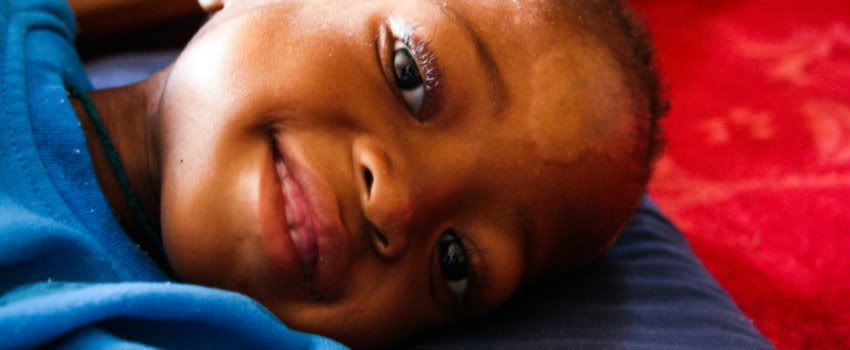
Phoofu was the first new baby to arrive at the safehome since I did three weeks ago. I am an undergraduate student from Notre Dame spending eight weeks at TTL this summer (…or winter here). After I spent a week settling in and getting used to all the faces in the safehome, a new one arrived. Phoofu did not have the weeks or even months of TTL’s care that the other babies did. He was tiny with frighteningly bloodshot eyes from living inside a smoky rondaval. And there was something else about his eyes.

They shook. They didn’t follow anyone or anything. They simply moved quickly from side to side wandering around the room. I asked one of the bo’me what this new baby’s name was. “Poof!” was what I conceived her response to be, so I said it back. After the laughter subsided, she handed me his bukana and I realized it was Phoofu (Pofe-oo). Well from then on he was Poof to me.

I held him when I accompanied Me’Mamosa to the hospital soon after he arrived. She explained to the doctor that he was referred to TTL because he was “abnormal.” He also had a very large soft spot on the back of his head that she wanted to check out. The doctor told her to avoid traumas to the head, but other than that, he was fine. But as Phoofu spent more time at TTL eating well and being cared for, it was clear there was something else different about him.

We looked forward to when Dr. Chris from BIPAI (Baylor International Pediatric AIDS Initiative) would come in the next couple weeks to get his opinion. During that time, Poof and I bonded. He began to make more noise and smile more- one of the cutest smiles I’ve ever seen, almost always preceded by a look of deep confusion or frustration that erupts into pure goofy joy. But during that time we also began to notice more issues with Phoofu.
At 10 months old, he couldn’t sit up by himself and wouldn’t hold his head up properly. When Dr. Chris finally came to TTL to check up on some of the little ones, I again got to hold Phoofu as he confirmed our suspicions that Phoofu has Down syndrome, in addition to hypotonia (low muscle mass) and severe eye problems. Though it was comforting to see him spending time on Phoofu, examining his eyes, legs, torso, and head, even noting to us the high arch in his mouth consistent with Down syndrome, I knew this was bad news.

I tried to figure out what this really means in a country I don’t know and a culture I am still so unfamiliar with, but I didn’t find anything encouraging. One report described the chances of a child with Down syndrome in rural areas of Lesotho reaching adolescence as “slight.” However, this was largely because of the medical care available. This is when TTL is so vitally important.
When Phoofu’s caregivers noticed something wrong, they were able to contact TTL. Now Phoofu is on a 5-hour drive into Maseru to see a disabilities specialist with his mother. I don’t know what they will be able to do for Phoofu and his family, but TTL is ensuring that he is going to the best place he can and will continue to provide Phoofu and his family support.

I’m not sure if I will get to say goodbye to Poof in the safehome before he returns to his village with his family. I’m not sure what his future will look like, living with a condition that can cause so many health problems. And I’m not sure if his family is in a position to provide him with the care he will need. But I do know that TTL’s committed outreach team will do everything they can for Phoofu, and for that, I am proud to be spending my summer learning from them.

Tuesday, May 10, 2011

Four Families Together Again


Four of our kids were reunited with their families in the past week, meaning that TTL was able to dramatically and positively alter the future of four kids who were either acutely ill or abandoned and in need of a caregiver (or both).
  • Mpontseng, a sweet four year old girl who was extremely sick and malnourished when she came to us almost two months ago, returned home to two healthy grandparents and an extended family that was beyond excited to have her back.
  • Kabelo, an orphaned baby boy who came to TTL when he was a few weeks old and stayed with us for the next six months, was taken in by a female relative that our outreach team worked for months to find.
  • Lipuo, whose mother died recently and whose father is unable to care for her, was reunited with her grandmother and older brother.
  • Tlholohelo, a hilarious baby girl who was initially in need of serious medical attention and nutritional support, returned home to her mother.
As with all the kids who transition out of the safehome back to their villages, we’ll keep a close eye on their progress with regular outreach visits. And new babies in need of support will inevitably fill in the spots vacated by the four who left.

In fact, when we dropped off Kabelo, it was with his grandfather and the grandfather’s young wife who were caring for at least eight other children of extended family members ranging from toddlers to pre-teens (they’ll be taking Kabelo to be cared for permanently by another family member in an even more remote village).

Among the group of kids living there was Kabelo’s three year old sister, whom we immediately noticed was malnourished and in need of medical attention. While it was undeniably disheartening and somewhat alarming to drop off one healthy baby in a household where another is clearly not thriving, it was also a relief to know that we could now help another child in need.

She’ll likely be coming to the safehome temporarily within the next few days. We’ll do what we can to boost her weight and overall health before returning her to her family, better off not only because of an enhanced health state but also because the long term outreach support from TTL will hopefully allow her to continue thriving. That’s the ideal outcome, at least, and the one we’ll do our best to achieve.

Tuesday, April 26, 2011

Death Before Dawn


This morning a baby girl died in my arms. Her last breath was abrupt and unsatisfying, the way an incomplete sentence hangs on the page: taunting, defiant, unnecessary.

We picked up Boikano on one of my first outreach trips. It was a memorable outing that involved driving well beyond the end of what should be considered a road, working with a village chief to assign a man on horseback to continue the journey, and then somehow intercepting a petite grandmother traversing a rocky mountain while carrying the malnourished and dehydrated three month old baby who we’d soon nurse back towards health at the safehome.

Once she arrived at TTL, Boikano gained weight quickly. She struggled with chronic sinus and respiratory infections, though she’d been relatively asymptomatic in the past couple weeks. She was also recently confirmed as HIV positive and was started on ARVs about 10 days ago. Her health was actually on the upswing. Until, of course, it wasn’t.

Yesterday afternoon she started looking listless, and by 5pm was running a high fever and had vomited once. We gave her medication to help bring down her temperature and tried to replenish her fluids, just as we’ve done dozens of time when similar scenarios arose with other babies. When I went to bed around 1am, the bo’me hadn’t come looking for me or Eric, indicating that Boikano was perhaps not better but likely not worse.

A few hours later, I awoke to a man’s voice, speaking softly in the dark outside my rondavel door. The words were English--otherwise I think my brain would have dismissed the voice as a passing shepherd guiding his herd down the road past TTL.

It had to be Eric, my co-fellow, in conversation with one of the bo’me from the safehome. After a minute of fumbling around to find a hoodie, I opened my door to the cold autumn darkness to see what was going on.

(Fall has just arrived in Mokhotlong--crisp, fragrant, and blustery-- and it is rapidly ushering away the the vibrant green foiliage and previously ubiquitous purple flowers, gradually polarizing the colors of the daytime landscape into two distinct camps: the assertive bright blue of the sky or the soft golden brown of the mountains).

I’d been the last to check on Boikano and since I often gravitate towards the medical side of our work anyway, I encouraged Eric to go back to bed while I went down to the safehome. Being awoken by the bo’me didn’t necessarily mean something critical was happening, but perhaps more importantly both of us knew there was little we could do in a crisis other than take her to the hospital where there would likely be no responsive medical staff and certainly no doctor on duty for hours.

Boikano was on the bedroom floor next to one of the bo’me, wrapped in a plastic sheet and a plush blue blanket. Even without a medical degree, I was pretty sure that she wouldn’t be long for this world and would in fact probably be dead within minutes. Her eyes were open but not tracking; in addition to being unconscious, her breathing was significantly more rapid and shallow than when I’d observed her respirations the previous evening, her hands and feet were icy, and there was moisture beading on her upper lip. I sat for a minute, trying to remember how to treat a a baby for shock or ARV-related toxicity or any other possible cause of her condition, knowing there wasn’t really anything I could do but not yet wanting to admit it.

I don’t have any experience with how death is supposed to be handled here but I have enough experience as a human to know that a baby deserves to die with as much comfort and love as possible in its last moments. I lifted her limp body and cradled her tiny body tightly, whispering things to her that I don’t even remember, watching life drain out of her until the last exhale.

The morgue is essentially within sight of TTL so it doesn’t take long to get there. And thanks to one of my predecessor’s blog posts about a similar experience, I was somewhat prepared. Not that getting down on hands and knees and leaning into a dark coffin-like chamber containing a dead adult male whose rigid cheek was only separated from my own by a thin sheet while I positioned Boikano on his chest was any more pleasant with the memory of Kevin’s blog post in my mind, but it helped to know certain practicalities like that it is standard to jam multiple bodies into one small, cold space and that I needed to leave a handwritten note on the door with the name, gender, time, and contact info before leaving.

When I returned to TTL the sun was still just a suggestion from beyond the horizon. I cried for the second time since being here (the first was last week, when Neo and Molefi left TTL for an orphanage--perhaps not an ideal outcome but at least their departure confirmed their health and the success of TTL’s initial intervention). Eric--who despite worshipping his sleep was not actually in bed when I returned--came over and managed to make me laugh, and the miracle of Skype meant that I could share the events with my boyfriend back in Seattle, all before dawn. Experienced, processed, released and done. Or something like that.

Now as I sit in my office next to the playroom, back to work as usual, I hope the rest of my day continues to be filled by the happy chortling of the babies and the comings and goings of the bo’me. And I also hope it’s a very long time before another early wake up call from the safehome.

Wednesday, March 30, 2011

The Smallest Superheroes

Any kind of meaningful experience should shift your perception of things, so perhaps that's why I am worse than I've ever been at guessing a child's age. When kids come to the TTL safehome, it's usually (ok, never) because their home situation and health status are great--quite the opposite, hence TTL's entire purpose. So even while we have an amazing success rate in terms of transforming tiny sick babies into chubby happy ones, the pre-TTL time of suffering still leaves a mark on rates of physical development.

Even though I know each safehome child's name, nickname, medications, favorite toys, alarming versus normal fussy cries, and signature spastic movements or other idiosyncrasies, I'm constantly re-checking our med charts to remind myself how old each one is; it's the one detail that my brain cannot seem to accept into the permanent archives, perhaps because every time I check a kid's age it seems like a surprise (we have a four month old who is stronger and almost as big as a two year old, for example). In almost all cases, our kids are much smaller than, say, their American counterparts.

It's no exaggeration to say that at first glance many of our kids or any of the many, many malnourished children in the rural areas surrounding TTL look months or even years younger than what my previous experiences with healthy, well-fed children would lead me to assume. One of my best friends at home has a baby around maybe five months old who is developing normally according to US standards but when I see pictures and videos she looks to me now through my TTL lens like a freakishly large and incredibly cognitively-gifted mini superhero.

Just last week we admitted two new children to the safehome, both our oldest here currently. Even though they are the most shy and withdrawn of our kids--not at all surprising since they are old enough to perceive the dramatic changes in their circumstances at a deeper level than the infants and thus more likely to struggle with fear and disorientation until they feel secure--we're confident they'll grow into their roles as the new king and queen of the TTL playroom. While initially reported as both being four years old, more research revealed that one is just under three and the other is four and a half. Yet before paperwork surfaced to confirm dates of birth, we were prepared to take initial reports at face value because in there is no reliable norm for kids who are that sick and malnourished.

Thankfully, TTL's focus on kids age 0-5 allows us to target kids in the most vulnerable early developmental stages and give them the best shot at making up lost ground. Between the safehome and our vast outreach network, we are able to reach hundreds of kids facing nutritional challenges, usually on top of other health conditions such as HIV or respiratory infections. Our safehome kids eat five times a day--three meals, two snacks or, for infants, as much bottle feeding as needed--and the frequency, quantity, and variety of foods they get is in no way the norm in Lesotho. On outreach, we commonly supply staples (such as corn meal and sorghum) as well as lots and lots of formula for babies whose mothers cannot breastfeed for a variety of reasons (sickness, death, disappearance, and the mother's own nutritional deficiencies are the most common).

While food security isn't necessarily at the heart of TTL's work, it's definitely a critical component of our work. Every mouthful helps these kids get one step closer to being back on track, and in their own way they are all turning out to be mini-superheroes.

Wednesday, March 16, 2011

Two Steps Forward...

Here we are in the middle of March and I’ve yet to update our loyal readers on the happening here in Mokhotlong--my apologies!

One of the problems with letting almost a month go by without a blog post is that so much happens, it’s hard to pick out just one incident to highlight. On the staff and volunteer side of things, the past few weeks have seen six volunteers come and go. Among this crowd was a four person medical team (led by TTLF Medical Director Dr. Amy Hutton from Chelan, WA) that spent two weeks interacting with babies in the safehome, assisting on outreach, and conducting some staff trainings on topics that our safehome coordinator identified as things that our caregivers encounter on a regular basis (these included hand-washing, vomiting, diarrhea, oral thrush, cough, TB, and rescue breathing). Then, this past weekend we welcomed two fourth year medical students from Cornell who are spending their last six weeks of med school doing an elective at the Mokhotlong Hospital located adjacent to the TTL campus just as my co-fellow departed for two weeks, giving me (and my boss) the chance to see how capable I really am here on my own.

The safehome has remained relatively full at eleven babies as of today. We bid farewell to one baby and one toddler at the end of February (some of you may have already seen pictures of baby boy Neo returning home to his mother and Nthabiseng’s last morning here on the TTLF Facebook page). Nthabiseng was the biggest and oldest child in the safehome while she was here, and she had a correspondingly large personality. Seeing her go was definitely bittersweet since so many of the staff had grown attached to her but transitioning a child back home is always a happy occasion as it marks incredible, undeniable improvement.

The outreach team will continue to provide her and her family with support and track her progress--something I have to remind myself of every time I think of the last hospital check-up I took Nthabiseng to for her final assessment with us, during which the nurses quite directly ordered me to adopt her because letting her go home meant letting her return to the same situation in which she became so sick to begin with.

Given the number of sick and malnourished babies that come through those hospital doors on a daily basis, I could definitely sympathize with the nurses’ skepticism. What I didn’t have time to add to the conversation was the fact that TTL clients have the unique advantage of long-term support through our dedicated outreach team. Caring for our clients is multi-stage process that goes beyond the most acute treatment phase; it involves a partnership between TTL and each child’s caregivers, who receive both supplies and education to help ensure the child’s health continues to improve.

For the most part, this model works, but it can’t guarantee 100% success. While Dr. Hutton’s medical team was here and working at the hospital, a mother came in with a baby who was suffering from advanced malnourishment. It’s not clear whether anything could have been done for the baby given the severity of his condition by the time he got to the hospital, but even after he arrived it took many hours for him to be seen by a doctor. The next day, he passed away lying next to his mother on a gurney in the pediatric ward. Adding to the tragedy is the fact that this child was a former TTL client who had graduated, meaning that his health was so stable for so long after we’d initially encountered him that he no longer needed the regular support of our outreach team. How a child can go from being so healthy to so very sick without intervention is not only perplexing but heartbreaking. Even though this kind of incident is rare, and even though it’s nearly impossible to pin down the exact place where things started to go wrong, it’s not acceptable. Thankfully there is no indication that Nthabiseng or any of our other clients are at risk for this kind of situation, but the reality is that things can go very wrong very quickly.

“One child at a time” is a fitting motto for TTL in so many ways, and if TTL wasn’t here there’s a good chance no one would be. Yet sometimes it’s still difficult to swallow the fact that no one can be there for every child every time.