Tuesday, April 6, 2010

Sticking Points

On a day-to-day basis here in Mokhotlong, little, random thoughts seem to pop into my head and stick there. They are miniature observations of life that have enormous staying power in my own growing conception of my surroundings here. They are lessons of a sort and everyday reminders that make me laugh. Some are important, others aren't. But I figure they are worth sharing.


So, here is the first entry of Sticking Points from TTL, which I might turn into a regular series on the blog.


1. Toddlers are easily amused after lunch. Not so much before.


2. True to their reputations, sheep are blind followers, donkeys are stubborn and bulls are aggressive. These traits are most clear from behind the wheel of a car.


3. It's extra important to check if the gas tank is full when driving to a place where gas stations don't exist.


4. When you speak English to a 3-year-old girl who only speaks Sesotho, she might think you are speaking gibberish and respond in kind. Adults who speak Sesotho can confirm this.


5. Bisquick pancake mix, Boboli pizza crust and bottled spaghetti sauce are luxuries, but food from scratch always tastes better.


6. Cinder blocks can be used for lots of things.


7. Life goes on despite the lack of paper towels.


8. Low in the Southern Hemisphere, the moon sprints out of the horizon.


9. "Pologna" is not as good as bologna. It's also more orange.


10. Older toddlers will pinch smaller ones when they feel it is deserved. The urge to reprimand such an action diminishes exponentially when it is, in fact, kind of deserved.


11. The best way to endear yourself to a child who is scared of you is to accidentally hurt yourself.


12. Dangerous-looking dogs are scared of getting rocks thrown at them. Thus, rocks are good.


13. Coloring is an enjoyable activity for 2-year-old boys. So is eating crayons.


14. A 4-year-old boy is better at keeping his family's dog away from his food than a stranger could ever be. This is because the little boy can punch the dog in the face, while the stranger most certainly cannot.


15. Contrary to popular belief, it is possible to run at full speed in gum boots.


16. Animals outside your rondaval can sound like they are in your bed with you, given the direction of the wind.


17. The sun is really efficient at drying clothes. Rain is really efficient at making them wet again.


18. Shy malnourished children can turn into gregarious healthy children.


19. As a foreigner in Mokhotlong, everyone on the street wants to know who you are, where you are coming from and where you are going -- especially other foreigners.


20. Children who are never told that bruised bananas are bad do not come to that conclusion on their own.


Monday, March 29, 2010

Lunchtime!


Ithateng getting a bottle shortly after arriving at the safehouse, Seithati munching away, and Nteboheng smiling for the camera in her bib... Gotta love lunchtime!

Friday, March 26, 2010

Another victory, another goodbye!


My buddy Thuso, who I've written about on the blog before, just went home today!

The picture is of him and me just a couple days ago, playing around with his favorite toy: my camera.

...a mere 36...

I had never given much thought to tuberculosis before coming to Mokhotlong. While it is indeed a lingering threat in the United States, it often flies under the radar. Out of sight, out of mind, I suppose.


Here, TB is a large enough problem that it is front and center in most medical providers' minds, right up there with HIV and malnutrition. It is also a common threat to our young clients' health, whether they are infected themselves or someone else in their household is infected. Small, smokey, one-room rondavals in which everyone in the family sleeps and breaths and coughs together aren't exactly the best place to spend a night with someone with TB. There is a section of Mokhotlong Hospital next door devoted to patients with multiple-drug-resistant TB. Our outreach teams ask questions about TB history within the household each time they fill out a new client intake form and each time they perform a monthly client check up.


In the World Health Organization's standards for defining symptomatic HIV infection, tuberculosis is considered one of only four "major signs" of infection. Co-infection of the two diseases means a dire outlook for a patient, especially in a place like Mokhotlong. Already compromised immunologically by the HIV, such patients have an extremely tough time fighting their TB and few resources to aid them in that fight.


On Wednesday morning, I happened to be in M'e Nthabeleng's office as she was checking TTL's email account, which is provided by our Lesotho-based Leo Internet Provider. The company has a homepage where they post country news, and the headline that popped up on Nthabeleng's computer caught my eye.


"HIV, TB cut Lesotho life expectancy to a mere 36."


"Woooh!" Nthabeleng said. "That is all you get in Lesotho."


Even though I've become accustomed to stark and shocking statistics in this country, particularly the sky-high statistics on HIV infection among people in my own age group, the final age of 36 jumped out at me as being particularly devastating. I immediately thought of all I still want to do in life -- I'm 24 -- and what dying in just 12 years would mean. More important, I thought of what that statistic would mean to me if I were a Mosotho, how it would affect my ambition, my drive, my optimism, and how it would inevitably mean a long line of my loved ones would die young even if I weren't infected myself.


Turns out the article -- the original source of which I am unsure of -- was posted in light of the fact that Wednesday was World TB Day. As such days are aimed at spreading awareness, I figured I would share my above thoughts on TB in Mokhotlong, as well as the article in its entirety below:


HIV, TB cut Lesotho life expectancy to a mere 36

March 24


Medical workers are increasingly concerned that the lethal combination of HIV infection and tuberculosis may become the world's next major health crisis.


To mark World TB Day on Wednesday, Medecins Sans Frontieres drew attention to Lesotho, which has the world's third-highest prevalence of HIV, the virus that causes AIDS, and the fourth-highest prevalence of tuberculosis. Here, poverty and violence complicate treatment in a country where life expectancy is a mere 36 years.


Michael Sidibe, head of the U.N. AIDS program, fears the double infection could become the next new epidemic.


"I'm calling for serious attention to TB, and serious attention to TB-HIV co-infection," he said in an interview.


In this mountainous kingdom surrounded by South Africa, some patients battling HIV and tuberculosis must walk five hours to reach a clinic for their medication.


"It is a problem for us to come to the clinic because sometimes there are gangster men waiting down by the side of the river … and yes, sometimes women are raped," said Tlalane Tsiane, a 21-year-old woman infected with TB and HIV.


Many men in Lesotho travel to South Africa to work in the mines and some return with HIV and a form of tuberculosis that is resistant to multiple antibiotics. The World Health Organization believes drug-resistant strains present a major challenge to the global effort to control the disease.


Helen Bygrave, a medical coordinator for Medecins Sans Frontieres, also known as Doctors Without Borders, estimated that between 80 and 90 percent of Lesotho's TB patients are infected with HIV.


A person whose immune system is compromised by HIV is particularly susceptible to tuberculosis, which is caused by bacteria that usually attack the lungs. The disease is spread through the air when an infected person coughs or sneezes.


There are nearly 9 million new cases of TB worldwide and the disease kills more than 1.5 million people every year, according to the World Health Organization, even though it can be cured with a six-month course of antibiotics that costs only $20.


Sera Thoola, a retired miner of 47, believes that he contracted TB in South Africa. It is also where he first tested positive for HIV. He has multiple-drug-resistant TB, and is currently taking an average of 49 pills a day to control his diseases.


Most clinics in Lesotho were set up through partnerships between the government and international groups. In seeking ways to make the most of the scarce resources, Medicins Sans Frontieres is helping to support and run a program in which nurses are given training to take on roles doctors might have carried out. Community health workers later make sure patients are sticking to their treatment regime.

Tuesday, March 23, 2010

Ups and Downs

Here at TTL, our motto is "One Child at a Time."


I remember that every time I think about the constantly evolving roster of babies in the safe home.


Here's another update:


Mosele, a seven-month old girl from the St. Martin area with a giant smile and sparkling eyes, went home today after spending three months in the safe home. She got here on December 23 after TTL found her severely malnourished. Her mother was severely ill at the time and didn't have the capacity to care for her.


Today, it's a different story. Mosele's mother has recovered, Mosele is in good health, and they are reunited. Another TTL victory!


Our success in helping Mosele follows sad news from last week, when another tiny little girl passed away just a day after coming under TTL's care. She was severely malnourished and dehydrated, had a rash all over her body and was presumed HIV positive. Our outreach team in the neighboring Thaba Tseka district found her and brought her halfway to Mokhotlong, where one of our local outreach teams met them to bring her the rest of the way. One of our caregivers spent the night with her in the hospital, and Kirsten spent a chunk of the night and a chunk of the morning there as well, trying to rehydrate the tiny girl without overwhelming her heart -- a tricky thing to do with the little resources available in Mokhotlong and the shape she was already in.


Unfortunately, that morning, she passed away. Her dehydrated state was too much for her to overcome.


Deaths like hers are the saddest part of what we do here, and really show you just how close some of the babies we help are to death. I wish we had found her sooner. Frustration is alive and well when these things happen, but it helps drive our desire for successes like Mosele's.


Back on that note, just as we gained some space with Mosele's departure this morning, another baby arrived.


Ithateng is a small three-month-old girl who has horrible oral thrush. As an existing client from the Malefiloane area, one of our outreach teams had gone to perform a regular monthly check up on her when they realized she wasn't doing well and needed more thorough and immediate help. So, they brought her back to the safe house.


She drank half a bottle soon after arriving here, and we've already started giving her medicine for the thrush -- purple drops that make her gums purple as well. She's really cute and I think her time here will do wonders for her health and well-being.


I think Thuso might be going home soon himself, which will be sad in a way but also another success story. He is thriving and has come so far from where he was a few short months ago, when he couldn't walk at all. Seithati is still getting bigger and stronger. She just now walked down the hallway between the playroom and the babies' bedroom to say good night to me after I popped my head out of the office. "Ntate," she said, smiling as I picked her up. Now that's a nice way to end a work day.


Nteboheng, our oldest child in the safe home at almost five years old, who I just recently wrote about, is getting better and better as well -- despite the fact that her CD4 count last week was an astoundingly low 6. For reference, kids her age are considered to have a severe CD4 suppression when their count goes below 500.


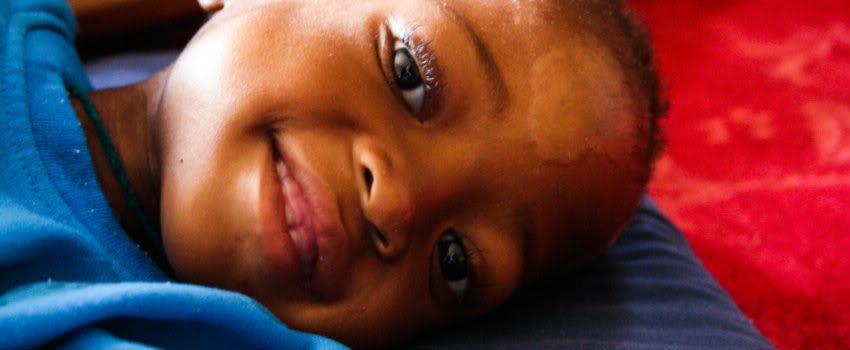
Still, yesterday she was dancing to the rhythmic singing of the bo'me, and today she couldn't hold back her smile after I told her I was going to take her picture. She's opening up -- a great sign!


More than anything else, these ups and downs in the safe home are what strike closest to home for me. They make this HIV epidemic we are fighting and the malnutrition that is all too common in this country so real, so in your face, so immediate. They instill in me the most appreciation for what TTL is doing on a regular basis.


Up or down, it is like our motto goes: "One Child at a Time."


And then another…and then another…